Mr. Lincolns White House Banner
Mr. Abraham Lincoln Abraham Lincoln's Residents and Visitors Abraham Lincoln and the Whitehouse Abraham Lincoln at Washington Abraham Lincoln's Nearby Washington Meeting Mr. Abraham Lincoln Abraham Lincoln's Visitors Center
Be friends with Abraham Lincoln on MySpace
Join our E-Newsletter  Bookmark Abraham Lincoln's White House search
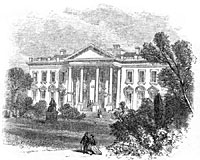
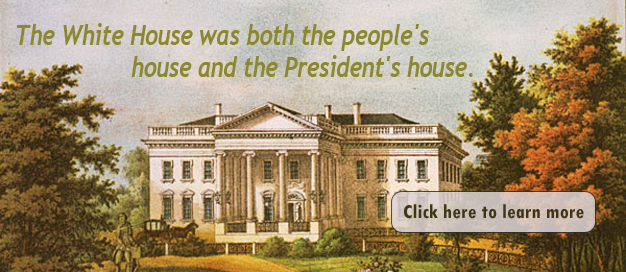
It was an "ill-kept and dirty rickety concern," according to presidential secretary John G. Nicolay. "I wonder how much longer a great nation, as ours is, will compel its ruler to live in such a small and dilapidated old shanty, and in such a shabby-genteel style." A Nicolay associate in the President's office was less critical, describing the White House as "a very respectable building of brick and stone, painted white, built in the form of a parallelogram, two stories high fronting north; but, owing to the declivity, three stories fronting south toward the Potomac." President Abraham Lincoln himself once called it "this damned house," and when he was besieged by office seekers and afflicted by bad news from the war front, the White House must have seemed truly damned. But, despite its drawbacks, the White House was a clear improvement on the family's previous living accommodations. Indeed, the President also declared it was "better than any house they have ever lived in." For the four years and one month of Mr. Lincoln's presidency from March 1861 to April 1865, it was home to the Lincoln family and the center of efforts to restore the Union and abolish slavery.

Mr. Lincoln's White House Daily Feature

Andrew G. Curtin (1817-1894)

Andrew G. Curtin (1817-1894)

Pennsylvania Governor, Andrew G. Curtin, was a determined supporter of President Lincoln's war efforts.
Click here for more details.

From the Founder of the Lincoln Institute

Lincoln at Peoria
The Turning Point


by Lewis E. Lehrman

Students of Abraham Lincoln know the canon of his major speeches – from his Lyceum Speech of 1838 to his “Final Remarks” delivered from a White House window, days before he was murdered in 1865. Less well-known are the two speeches given at Springfield and Peoria two weeks apart in 1854. They marked Mr. Lincoln’s reentry into the politics of Illinois and, as he could not know, his preparation for the Presidency in 1861. These Lincoln addresses catapulted him into the debates over slavery which dominated Illinois and national politics for the rest of the decade.

For more information visit LincolnatPeoria.com.

Lincoln at Washington
Grasping for the Consequences

by Lewis E. Lehrman

Artist Francis B. Carpenter said that Abraham Lincoln referred to his office in the White House as the "shop."1 Illinois attorney Henry Clay Whitney observed that for President "Lincoln the stately mansion was a mere workshop for the performance of dreary, routine labor."2 Whitney wrote that Lincoln, who had once run and owned a country store, "eschewed all diplomatic or stately terms; could not be induced to speak of his house as the Executive Mansion, but termed it 'this place,' or of his room at the Capitol as the 'President's' room; he disliked exceedingly to be called 'Mr. President,' and he requested persons with whom he was quite familiar and saw often to call him plain 'Lincoln;' he always spoke of the war as 'this great trouble.'"3

Click here for more details.

Mr. Lincoln | Residents & Visitors | The White House | Nearby Washington | Meeting Mr. Lincoln | Visitors Center | Search

Official Lincoln Institute Websites:
Mr. Lincoln and Freedom | Mr. Lincoln and Friends | Mr. Lincoln and the Founders | Abraham Lincoln’s Classroom

Mr. Lincoln's White House © 1999 - 2008 The Lincoln Institute. All rights reserved. A project of The Lincoln Institute under a grant from The Lehrman Institute.

White House Illustration courtesy of Library of Congress Prints and Photographs Division Washington. Reproduction Number: LC-USZC4-3366.